
Victoria’s commercial property sector in 2025 is characterised by renewed investor focus on secondary and regional markets. Rising urban density, infrastructure-led expansion, and planning policies are prompting a strategic pivot beyond core zones such as Maidstone. This shift is underpinned by a requirement for scalable commercial assets in proximity to growing residential corridors.
Growth
State-led infrastructure initiatives and planning reforms continue to enhance the investment profile of suburban and regional precincts. The Victorian Infrastructure Strategy and Plan Melbourne policy framework are enabling targeted decentralisation, while commercial developers benefit from improved transport linkages, employment hubs, and council-facilitated zoning adjustments.
Glenroy
Glenroy has transitioned into a priority development area, highlighted by a $33 million sale of the former Australia Post facility near Glenroy Station. The precinct is part of a $500 million combined public-private investment program, with the $285 million level crossing removal acting as the catalyst for high-density zoning and commercial redevelopment. The locality now presents potential for long-term capital yield driven by mixed-use tenancy and residential growth.
Cranbourne
Cranbourne is undergoing large-scale industrial transformation. Frasers Property and ESR have committed to a $900 million high-tech logistics estate across 64.4 hectares, catering to e-commerce fulfilment, light manufacturing, and distribution sectors. The site offers future-facing warehousing automation infrastructure and benefits from its positioning along the South Gippsland freight corridor. This asset class is aligned with sustained warehousing demand and tenant pre-commitment strategies.
Williams Landing
Williams Landing is a strategically planned business centre in Melbourne’s west. Its 50-hectare commercial footprint includes 200,000 sqm of retail and office space, anchored by state government offices and national corporate tenancies. Future employment forecasts estimate over 13,000 white-collar jobs, facilitated by proximity to a regional public transport interchange. The area demonstrates strong leasing resilience and multi-sector tenancy appeal.
Frankston
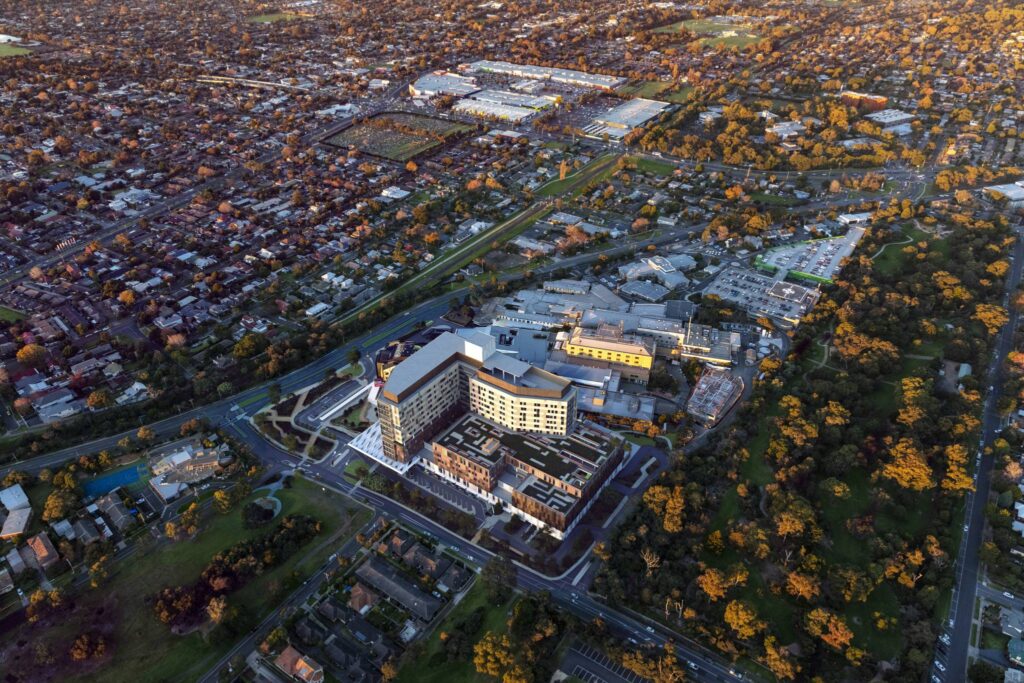
Frankston has emerged as a core commercial healthcare precinct, driven by the $1.1 billion Frankston Hospital redevelopment. This includes a 12-storey clinical tower, mental health units, and an expanded emergency facility. Adjacent commercial spaces ranging from 30–117 sqm are now positioned for stable yield from healthcare-adjacent operators, supported by increased daily visitation and hospital staff occupancy.
Delacombe
Delacombe, situated in the Ballarat West Growth Area, is identified for regional-scale urban expansion. The suburb is projected to house over 12,000 residents by 2030 and is supported by a structured planning scheme that includes the Delacombe Town Centre and a designated future activity node. Commercial parcels in the area offer low-entry pricing and predictable growth driven by residential catchment absorption.
Summary
The following areas present distinct commercial advantages based on asset class and strategic positioning:
- Glenroy – High-density mixed-use redevelopment.
- Cranbourne – Institutional-grade industrial logistics hub.
- Williams Landing – White-collar employment and government leasing base.
- Frankston – Health-driven tenancy with essential service anchor.
- Delacombe – Regional affordability with planned infrastructure backing.
Risk
Commercial property investment in growth corridors involves exposure to planning risk, infrastructure delivery timelines, and changing macroeconomic indicators. Key considerations include interest rate sensitivity, construction input cost volatility, and council-specific zoning controls. Investors must engage in due diligence and consult updated precinct structure plans before capital deployment.
Victoria’s commercial property market in 2025 reflects a decisive shift toward infrastructure-aligned investment opportunities outside legacy precincts. Suburbs such as Glenroy, Cranbourne, Williams Landing, Frankston, and Delacombe are each positioned to deliver capital appreciation and secure tenancy based on their embedded transport, employment, or demographic growth dynamics. Investment strategies should prioritise asset class suitability, planning certainty, and alignment with local economic functions.